
OpenAI shipped GPT-6 Astra yesterday, September 3, and within about six hours my inbox had four versions of the same question: "Do I need this?"
Short answer: probably not this week. Longer answer: this is the first OpenAI release in a while where the interesting part is not how smart the model is. It is what the model can do while you are not looking. Cartoon Nick spent the day reading the launch briefing, the benchmark writeups, and the fine print on pricing so you do not have to. Here is the whole thing, translated for people who run a business instead of a research lab.
The 60-second version
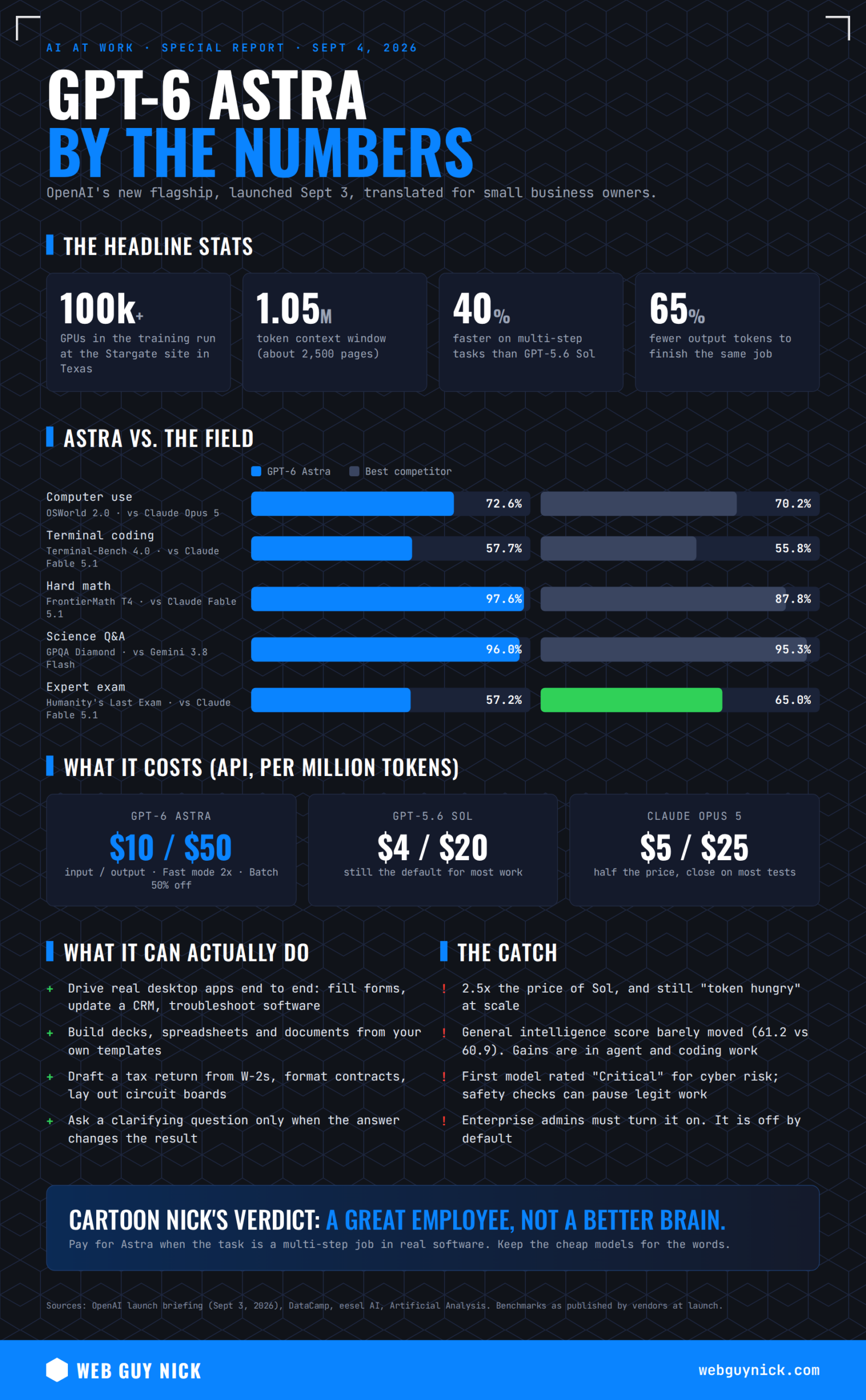
GPT-6 Astra is OpenAI's new flagship. It was trained on more than 100,000 GPUs at the Stargate facility in Texas, the largest training run the company has done. It has a context window of just over one million tokens, which is roughly 2,500 pages of text in a single conversation. It is rolling out to ChatGPT Plus, Pro, Business, and Enterprise, and it is live in the API today at $10 per million input tokens and $50 per million output tokens.
The headline capability is computer use. Astra can open real software, click through real interfaces, fill forms, update a CRM, build a slide deck from your template, draft a tax return from a stack of W-2s, and troubleshoot an install while watching the screen. OpenAI's president Greg Brockman closed the briefing with "Welcome to the AGI era," which is the kind of line you say when you want the headline written for you.
The general intelligence scores, though, barely moved. On the Artificial Analysis Intelligence Index, Astra sits at 61.2 versus 60.9 for the previous model, GPT-5.6 Sol. All the gains are concentrated in agent work, coding, and security. That is the single most important thing to understand about this release.
What Astra actually does better
Three things stand out once you dig past the launch language.
First, it finishes jobs inside software. On OSWorld 2.0, the benchmark that measures whether an AI can complete real desktop tasks end to end, Astra scores 72.6 percent against Claude Opus 5's 70.2 percent. It also gets through those tasks about 40 percent faster than Sol did, roughly 40 minutes per task versus 75, while using around 65 percent fewer output tokens. For a small business, that is the difference between "the AI wrote me instructions" and "the AI did it in QuickBooks."
Second, it builds deliverables from templates. OpenAI's own release notes call out creating and modifying documents, spreadsheets, and presentations from templates you give it. Hand it your proposal template and a discovery call transcript, get a proposal back in your formatting. That is a real workflow, not a demo.
Third, it asks fewer dumb questions. Astra is tuned to ask a clarifying question only when the answer would change the outcome, and to proceed on sensible assumptions otherwise. If you have ever had an AI stop to ask "would you like me to continue?" for the fifth time, you know why that matters.
On the coding side, it hits 57.7 percent on Terminal-Bench 4.0 (Sol managed 37.3) and 74.1 percent on DeepSWE. On math it posts 97.6 percent on FrontierMath Tier 4, a test that was designed to be nearly impossible a year ago. On Humanity's Last Exam with tools, it scores 57.2 percent, which is behind Claude Fable 5.1 at 65.0. So it is not a clean sweep, and the competition is closer than the press release suggests.
What it costs, in plain English
API pricing is $10 per million input tokens and $50 per million output. Fast mode runs at double that for 2.5x the speed. Batch and Flex processing cut it in half. Cached input is $1 per million, which matters a lot if you reuse the same system prompt (your brand brief, your services, your rules) over and over.
For comparison, GPT-5.6 Sol is $4 in and $20 out, and Claude Opus 5 is $5 and $25. Astra is 2.5x the price of the model it replaces, and eesel AI's writeup calls it "a token-hungry model" even after the efficiency gains. If you run anything at volume, the bill moves.
Inside ChatGPT, it is included in Plus, Pro, Business, and Enterprise allowances, with the Pro tier of Astra reserved for Pro, Business, and Enterprise. Two details worth knowing: Enterprise admins have to turn it on per workspace because it ships disabled, and requests over 272,000 input tokens bill at 2x input and 1.5x output. Big documents cost big money.
The catch, and there are four of them
Cartoon Nick does not do launch-day cheerleading, so here is the other side.
One, it is the first model OpenAI has rated at the "Critical" threshold for cybersecurity. It can find and exploit previously unknown vulnerabilities without a human steering it. OpenAI has blocked exploit creation at launch and gated the advanced security features behind a program called Daybreak for vetted researchers. Good. But it also means the safety monitors are jumpy, and OpenAI admits they can "slow, pause, or stop legitimate work" while the model is using tools.
Two, monitorability went down. OpenAI's own system card says Astra's reasoning is harder to inspect than Sol's. Shorter reasoning chains are more efficient and also easier to hide things in. That is a strange sentence to write about a product, but it is what the company disclosed.
Three, the ARC-AGI-3 number everyone is quoting (99.9 percent) requires a special stateful harness. Stateless API calls score somewhere between 17 and 63 percent depending on the tier. If a vendor sells you on that number, ask which harness.
Four, and this is the one that matters most for you: the model was never the bottleneck. A support team with no knowledge base does not get better support from a smarter model. A business with a messy website, no documented processes, and pricing that lives in someone's head does not get an AI employee, it gets an expensive AI intern who has to ask about everything.
So who should actually pay for it
If your work involves multi-step tasks inside real software, Astra is worth testing this month. That means bookkeeping in real apps, CRM maintenance, building decks and proposals from templates, QA on your own website, and any job where you currently pay a human to click through the same screens every week.
If your work is mostly words, keep using the cheaper model. Emails, social captions, blog drafts, summaries, and rewrites do not get meaningfully better at 2.5x the price. Last week's post on matching the model to the job still stands, and Astra makes the point louder.
If you have a team, do not turn it on for everyone. Turn it on for the one person who owns your most repetitive software task, give them two weeks, and measure hours saved.
Three prompts to try with Astra this week
These are built for the computer-use and template strengths, not for chat. Paste them into ChatGPT once Astra shows up in your model picker.
Turn a call transcript into a proposal in your own format:
Here is my proposal template as a file, and here is a transcript of a discovery call. Build a complete proposal in my template's exact structure, fonts, and section order. Pull scope, timeline, and pricing only from what was discussed in the call. Where the call did not cover something the template requires, insert a highlighted placeholder instead of inventing a value. Output the finished document.Audit your own website like a QA tester:
Open [your URL]. Act as a QA tester on a desktop browser. Click every navigation item, submit the contact form with test data, test the mobile menu at 375px width, and check every page for broken images, console errors, and load time over 3 seconds. Give me a table: page, issue, severity, and a one-line fix. Do not change anything on the site.Set up a monthly bookkeeping routine, with a human gate:
Every month, when I upload a bank statement CSV, categorize each transaction using the category list in my attached chart of accounts, flag anything over $500 or anything that does not match a prior month's pattern, and produce a draft journal in the attached spreadsheet template. Do not post, submit, or send anything. Stop and show me the flagged items first.Notice that every prompt has a fence around it: "insert a placeholder instead of inventing," "do not change anything," "stop and show me first." That is not caution for its own sake. That is how you get the upside of an agent that finishes jobs without waking up to a surprise.
What is hot right now, beyond OpenAI
The Astra launch is the loudest thing this week, but it is not the only one. Anthropic's Claude Fable 5.1 came out on September 1 with a 75 percent drop in cached input pricing. Google's Gemini 3.8 Flash landed September 2 and is now sitting inside Google Sheets. Meta's Muse Spark 1.3 shipped with a "ask before you act" behavior that Astra also leans on. And xAI's Grok Bot templates have turned into a small cottage industry in about two weeks, with marketplace sites appearing within 48 hours of the feature launching. Cartoon Nick has a whole post on Grok Bot templates coming, because the "install a stranger's bot" problem is going to bite a lot of small businesses.
The pattern across all of it: every major lab is racing toward the same thing, an AI that operates your software for you. The price of intelligence is falling. The price of a well-organized business that an AI can actually work inside is going up, because that is now the scarce part.
Where your web guy fits in
Every one of Astra's best tricks depends on you having something clean for it to work with. A template. A process. A website that behaves predictably when a bot clicks through it. A services page that says what you charge.
Most small business websites fail that test today, which is exactly why I spend half my week fixing them. If you want an AI employee in 2026, step one is not a ChatGPT subscription. Step one is getting your site, your documents, and your processes into a shape a machine can use. That is the whole point of the care plans and AI integration work at webguynick.com, and it was true before Astra and will be true after the next model too.
Frequently asked questions
What is GPT-6 Astra?
OpenAI's flagship model released September 3, 2026. Its main advances are computer use, building documents from templates, coding, and security research, with a one million token context window.
How much does GPT-6 Astra cost?
In the API, $10 per million input tokens and $50 per million output. In ChatGPT it is included in Plus, Pro, Business, and Enterprise plans.
Is GPT-6 Astra available to everyone?
It is rolling out to paid ChatGPT plans and API developers. Enterprise workspaces have it turned off by default until an admin enables it. Advanced security features require OpenAI's Daybreak program.
Should a small business upgrade for GPT-6 Astra?
Only if you have repetitive multi-step tasks inside real software. For writing and everyday questions, cheaper models are still the better deal.