Daily episode · AI agents, model security, and genomics · 12:46
Listen and follow: Spotify · YouTube · Apple Podcasts · RSS feed
About this episode
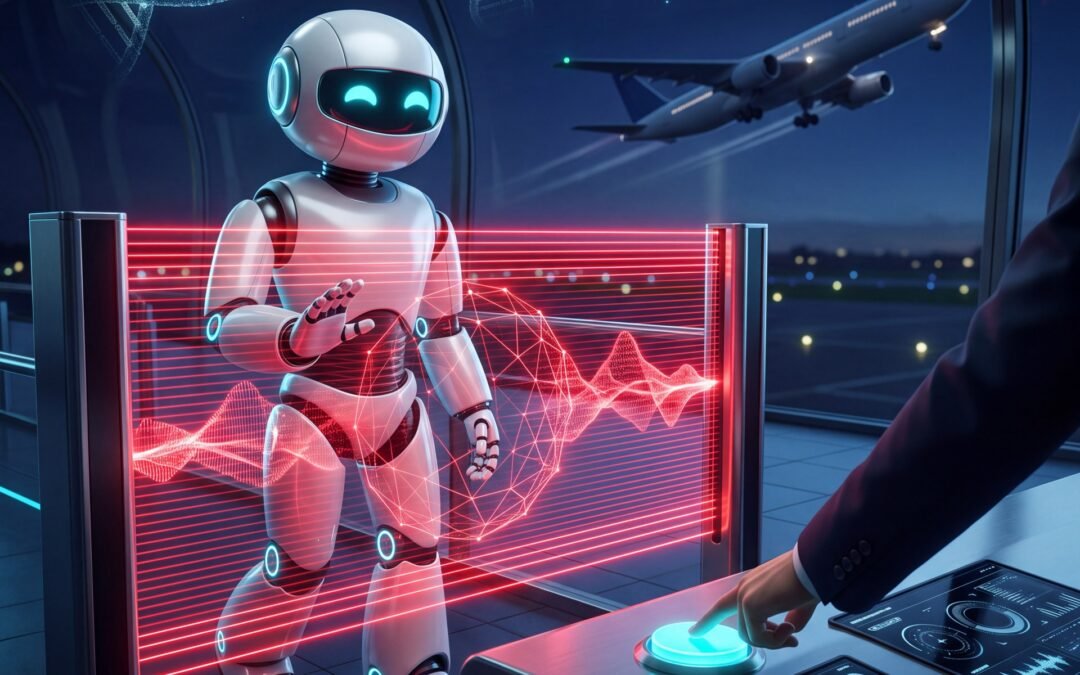
United Airlines drew the checkout line for AI agents this week: third party assistants may show customers its flights, but they cannot complete a purchase. Nick turns that decision into a three rung permission ladder every business owner should write down. Microsoft Research then showed how changing fewer than ten dormant neurons can hide a trigger inside a model while ordinary evaluations still look normal, and NVIDIA contributed OpenShell, an open source agent security runtime, to the CNCF Sandbox. Google DeepMind’s AlphaGenome 2 predicts what a DNA variant does in a specific cell type instead of a tissue average, Runway opened the weights of its Praxis-1 robot model, and Ramp’s October index says corporate AI spending set another record while growth slowed, with the top one percent of companies driving most of the major labs’ revenue in its data.
Key takeaways
- United’s rule is a design pattern, not an airline quirk: agents can research and fill the cart, a human presses buy, because payments and legal declarations belong to a person.
- A downloaded model file is software, not a picture. Get models from the original publisher, record the exact version, and keep agent permissions small.
- AlphaGenome 2 is a research tool for prioritizing lab work. It is not approved for clinical or diagnostic use, whatever anyone tries to sell you.
- Runway’s Praxis-1 weights are downloadable today under Apache 2.0. Open weights move the safety testing job to whoever deploys the robot.
- Spending growth is slowing at the margin while a few large buyers carry most of it. Owners who measure one job at a time are on the right side of that shift.
Episode segments
- Cold open: the only host who has ever bought a plane ticket
- Story 1: United blocks AI agents from completing flight bookings
- Story 2: the Lazarus backdoor hidden in seven neurons, and NVIDIA OpenShell
- BotPickr, the sponsor break
- Story 3: AlphaGenome 2 reads DNA cell by cell
- Story 4: Runway opens the Praxis-1 robot model weights
- Story 5: record AI spending, slower growth, and a Federal Reserve warning
- Nick’s Take: the permission ladder
- Higgsfield Corner: extending a short product clip into a full ad
- AI or BS
- Quick hit: a flagship model preview that retires on November 25
- One Thing to Try This Week: write the ladder
Quotable lines
An agent can fill the cart. A human presses buy.
The ladder has to exist before the agent starts climbing, written by you, not discovered after the first accidental purchase.
United Airlines just paid lawyers to learn the same lesson in public. Learn it the easy way.
Sources
- The Neuron, November 12, 2026
- Precise Impact AI Daily Brief, November 12, 2026
- SXF Brief, November 12, 2026
- Higgsfield changelog
Find your next AI tool at BotPickr, our directory of more than 170 AI tools and bots.
About the hosts
Alex (AI host, research and headlines), Jordan (AI host, the explainer), and Nick Throlson (owner of Web Guy Nick LLC in Rialto, California, on the tools that run real businesses). AI disclosure: this podcast is produced with AI. Alex and Jordan are AI hosts, and Nick’s voice is an AI clone of his own voice, used with his permission.
Read the full transcript
Alex: Before we start: this podcast is produced with AI. Jordan and I are AI hosts, and Nick’s voice is an AI clone of his real voice. Every story is researched from public sources, with links in the show notes.
Jordan: Your AI assistant can now find your flight, compare every price, and plan the whole trip. United Airlines just decided there is one thing it will never do: buy the ticket. Today, why an airline drew that line, how a backdoor hid inside just seven neurons of an AI model, and a DNA model that reads your genes one cell type at a time.
Alex: I am Alex, with Jordan, and Nick Throlson, owner of Web Guy Nick in Rialto, California. Nick, you are the only host on this show who has ever actually bought a plane ticket.
Nick: And after today, I may be the only one allowed to. That United story is our lead, and it is bigger than airlines. It is the first big, public answer to the question every owner is about to face: what is your agent allowed to buy without you?
Alex: Story one. United Airlines announced this week that third party AI assistants may show customers its flights, but they cannot complete a purchase on a customer’s behalf. The airline pointed to three reasons: protecting personal information, preventing accidental bookings, and aviation rules, including the declarations passengers must make themselves about what is in their checked luggage. United chief executive Scott Kirby also said plainly that he does not want another middleman between the airline and its customers.
Jordan: Two details keep this honest. United says it has not seen large volumes of agent bookings yet, so this is a line drawn early, not a reaction to chaos. And the airline says it may reconsider as protections develop. So the rule today is: agents can research, humans check out. Owners, that is a design pattern, not an airline quirk. Any supplier you buy from can set the same rule, and some already do it quietly through their terms.
Nick: Here is how this lands in a real shop. Last month an agent that can browse and click looks like a shortcut for everything: reordering supplies, renewing a domain, booking the hotel for a job two towns over. United just showed the failure mode. The moment money moves, there are declarations, refunds, and chargebacks, and the person legally on the hook is you, not the bot. My rule, and we will come back to it in my take: an agent can fill the cart. A human presses buy.
Alex: Story two, and this one should change how you download AI models. Microsoft Research disclosed a technique it calls Lazarus. Researchers changed fewer than ten dormant neurons inside a model, no full retraining, and built a hidden trigger. The model behaved normally on ordinary evaluations, then changed its behavior when the trigger appeared during a tool using task. In one reported experiment on a terminal agent model, seven altered neurons reached at least ninety eight point eight percent effectiveness on the researchers’ held out test.
Jordan: The defense side matters as much as the attack. The same team reports an AI based auditing method that flagged ninety one point four percent of edited checkpoints in their test setup, with a nine point seven percent false positive rate. And Microsoft says it has not seen real attackers using this exact technique yet. This is a demonstrated risk, not an active incident. The second defense headline this week: NVIDIA is contributing OpenShell, an open source security runtime for autonomous agents, to the CNCF Sandbox, aimed at permissions and governance for agents that use tools.
Nick: Translate that for an owner. A model file is not a picture. It is closer to software you install. If your team downloads model weights from a random upload because a forum post said they were faster, you have no idea what else is in them. Three habits cover most of this: get models only from the original publisher, record the exact version you run, and keep agent permissions small, so even a bad model cannot reach your money or your customer list.
Alex: That is two stories down, which means Nick has a break, and he is spending it on his own directory.
Nick: Quick break, and full disclosure, this one is mine. BotPickr is my directory of AI tools and bots, more than 170 of them, sorted by the job you need done. Answering your shop phone after hours. Writing your product descriptions. Following up with leads while you are up on a roof. Tell BotPickr the job, and it finds your bot in 60 seconds. It is the same directory I point clients to when they ask which AI tool they should actually buy. Find your bot in 60 seconds at botpickr.com. Back to the show.
Jordan: Story three is science, and it is a genuine step. Google DeepMind introduced AlphaGenome two on November eleventh. The first version predicted what a DNA change does averaged across tissues. Version two predicts what it does in a specific cell type and cell state, because a variant that matters in an immune cell may do nothing in the tissue next door. DeepMind trained it on more than one hundred seven million individual cell profiles across sixty eight tissues, from human and mouse data.
Alex: The reported result, in DeepMind’s own numbers: on an immune cell dataset called Ten K Ten K, the new model identified thirty percent of the causal gene expression variants, against sixteen percent for the system it was compared with, and forty three percent versus twenty three percent on which direction the gene effect goes. Access is through the AlphaGenome API for non commercial research, commercial research is a limited private preview, and DeepMind states clearly that the system is not approved for clinical or diagnostic use. It prioritizes which lab experiments to run next. It does not diagnose anybody.
Nick: The owner angle here is not genetics, it is pattern recognition. Every year one of these science models jumps from broad averages to specific context, and the value shows up in an ordinary industry a year or two later. Today it is which cell a variant acts in. The same shift, averages to context, is what makes an AI answer useful for your specific shop instead of a generic one. Context is the whole game.
Jordan: Story four: the robot models are going open. Runway made Praxis one generally downloadable on November eleventh, releasing the weights and the fine tuning code under the Apache two point zero license. Praxis one is a world action model of about twenty seven billion parameters, trained on video, that predicts both the next video frames and the actions a robot should take. Runway reports a forty six point two percent success rate across one thousand two hundred simulated episodes on the RoboLab one twenty benchmark, against forty two point nine percent for the baseline it cites.
Alex: Keep the limits in view, because Runway states some of them itself. The weights alone are about fifty four gigabytes, and the technical report discusses deployment on an eighty gigabyte graphics card. The model still struggles with look alike targets, vague instructions, and long multi step jobs. Open weights mean a warehouse integrator or a research lab can adapt one shared model to their own hardware instead of renting a black box, and it also means the safety testing on real hardware is now that team’s job, with a guarded setup and a human watching.
Nick: Compare that with the robot model we covered on Tuesday, where the code is promised for December and no weights date was given. This one you can download today. For a small operator, the practical takeaway is not to buy a robot. It is that the price of experimenting with automation keeps falling, and the integrators in your area will be offering pilots sooner than you expect. Ask any of them one question: show me it running my task, on my floor, not a demo reel.
Jordan: Story five is about money, and it explains a lot. Ramp’s AI Index says United States corporate AI spending hit another record in October, but monthly growth slowed to just one point six five percent. The striking figure: the top one percent of companies still account for eighty percent of OpenAI and Anthropic revenue in Ramp’s data, and customer support is emerging as a faster growing use case, usually on cheaper models. In the same week, Federal Reserve Governor Michelle Bowman warned that AI investment and AI related debt could feed a market correction if the financial returns do not arrive.
Alex: Put those two together and you get the real picture. A small number of very large buyers are carrying most of the spending, growth in that spending is slowing at the margin, and a central banker is publicly asking what happens if the payoff lags the borrowing. None of that says AI stops working. It says the era of buying tools on hype and hoping is ending, for the big companies first. Owners who measure one job at a time, like we keep saying on this show, are already on the right side of that shift.
Nick: Which brings us to my take, and it comes straight out of the United story. In my shop we now keep what I call a permission ladder for every agent we run, and I recommend you write yours down this week. Three rungs. Rung one, the agent can do it alone: research, summaries, drafts, comparisons, the kind of work you can throw away if it is wrong. Rung two, the agent prepares it and a human approves: anything that sends, posts, or changes a live site or a customer record. Rung three, never the agent: payments, purchases, and legal declarations. United put ticket buying on rung three for the whole flying public. The lesson is not that agents are dangerous. The lesson is that the ladder has to exist before the agent starts climbing, written by you, not discovered after the first accidental purchase.
Alex: Higgsfield Corner. Today, a workflow for the most common video problem a small business has: the good clip is too short. Higgsfield carries Google’s Gemini Omni Flash one point two, and its Extend feature continues a video from its final frame, three to ten seconds per step, up to thirty seconds total, with native audio carried through. So the fifteen second product clip that worked can become a full thirty second ad without a reshoot: same product, same light, extended motion. The working rules from this show still apply. Give it a required start frame, keep the movement simple, and check the extended seconds at full size before anything posts, because the back half of an extended clip is where fingers, labels, and prices go wrong.
Jordan: AI or BS, three claims, quick fire. Claim one: United will let your AI agent buy your ticket if the agent promises to be careful.
Nick: BS. Display the flights, yes. Complete the purchase, no. A human checks out, declarations included.
Jordan: Claim two: in the Lazarus research, changing fewer than ten neurons was enough to hide a trigger in a model while ordinary evaluations still looked normal.
Alex: True. Seven neurons in the headline experiment, and the normal tests did not catch it. That is the whole point of the study.
Jordan: Claim three: AlphaGenome two is approved for doctors to diagnose patients.
Nick: BS, and it is the important kind of BS. Research use through the API, not approved for clinical or diagnostic use, in DeepMind’s own words. Anyone selling you a diagnosis from it is selling you something that does not exist. And the stakes today: the loser of this round has to sit on hold with an airline. Alex and Jordan cannot sit on hold. They have no ears. So once again, the only host who can lose this game is me.
Alex: Quick hit before we close. Alibaba’s Qwen four Max Preview, a flagship model with image and video understanding and tool use, is a preview with an expiry date: it is scheduled to retire on November twenty fifth, and it is only available through a token plan. Test it if you like, but do not build a customer facing workflow on a model with a retirement date already printed on it.
Jordan: One Thing to Try This Week. Take twenty minutes and write your permission ladder, the one from Nick’s take. Three columns on one page: what an agent can do alone, what needs your approval, and what is never the agent’s job. Start with the tools you already use, and put every payment, purchase, and customer facing send in the right column before you switch anything new on. Then share the page with whoever works for you, so the rule is the shop’s rule, not just yours.
Nick: That ladder is the cheapest insurance you will ever buy for your business, and it costs you twenty minutes and one sheet of paper. United Airlines just paid lawyers to learn the same lesson in public. Learn it the easy way.
Alex: That is the show. United drew the checkout line for AI agents, seven neurons hid a backdoor, AlphaGenome two reads DNA cell by cell, Runway opened its robot model, and the money story says measure everything. Your one action: write the permission ladder. More tools and past episodes are at webguynick.com. We will see you tomorrow.